Nature
 PUBLISHED


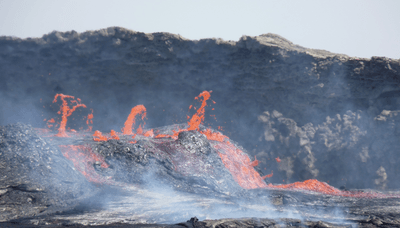


Geologists have attributed age-dependent variations in the chemistry of Ethiopian volcanic rocks to rhythmic pulses like a "heartbeat" in the Afar mantle plume. The plume drives volcanic activity in the area and is leading to the breakup of the African continent.
At various points around the Earth, unusually hot mantle material is rising, sometimes from the edge of the Earth’s core, to punch holes in the Earth’s crust, creating volcanic hotspots. The Afar plume is unique in that the plume is breaking through continental crust, not the thinner oceanic crust like in places like Hawai'i. Evidence recently emerged, however, of a “ghost plume” beneath Oman that has not been strong enough to reach the surface, but has nevertheless reshaped the geography of the area.
Unsurprisingly, the Afar plume is the subject of intensive study, offering insight into tectonic activity we can’t witness anywhere else. Three active rifts meet above the plume, again something not seen anywhere else. Now, Dr Emma Watts, then at the University of Southampton, has led a team that explored the rocks produced in eruptions generated by the plume.
[The pulse's timing] is likely on a timescale of millions of years.
Dr Emma Watts
“We found that the mantle beneath Afar is not uniform or stationary – it pulses, and these pulses carry distinct chemical signatures,” Watts said in a statement. “These ascending pulses of partially molten mantle are channelled by the rifting plates above. That’s important for how we think about the interaction between Earth’s interior and its surface.”

“The chemical striping suggests the plume is pulsing, like a heartbeat," Professor Tom Gernon added. "These pulses appear to behave differently depending on the thickness of the plate, and how fast it’s pulling apart. In faster-spreading rifts like the Red Sea, the pulses travel more efficiently and regularly like a pulse through a narrow artery.”
“These pulsations in the mantle plume are likely a result of heterogeneities within the source of the upwelling, deep in the mantle. All the pulses we observe have slightly different compositions and hence have different properties that we could pick up through our analysis. The overall cause of the heterogeneities in the mantle is likely the long-term recycling of material into the mantle through plate tectonics as well as parts of the mantle that are primitive (untapped),” Watts told IFLScience.
“We have found that the evolution of deep mantle upwellings is intimately tied to the motion of the plates above. This has profound implications for how we interpret surface volcanism, earthquake activity, and the process of continental breakup,” said Dr Derek Keir. “The work shows that deep mantle upwellings can flow beneath the base of tectonic plates and help to focus volcanic activity to where the tectonic plate is thinnest. Follow-on research includes understanding how and at what rate mantle flow occurs beneath plates."

The first of the three rifts centred on Afar initiated about 35 million years ago, while the others followed with gaps of around 12 million years each.
The authors compared 130 samples that were all less than 2.6 million years old, made by volcanoes that have been recently active, and compared them with the older material around the region. The focus on the most recent part of the plume’s life prevented precise estimation of the pulse’s timing, but Watts told IFLScience, “It is likely on a timescale of millions of years.” The heartbeat of the Earth is slow.
Although the pulses are specific to the Afar plume, Watts also noted to IFLScience, “Some other mantle plumes (e.g. Canary plume) have been observed to see a chemical pulsatory signature.” On the other hand, the Hawaiian plume, among others, has a composition that varies in space, rather than time, with different chemistries detected side by side.
The study is published in Nature Geoscience.